18 June 2015
Heroes
12 April 2013
The Gas Bubble
The devastating environmental effects of the process are well documented, and not the subject of this essay (water depletion, water pollution, habitat and farmland destruction, and significant climate change impacts).
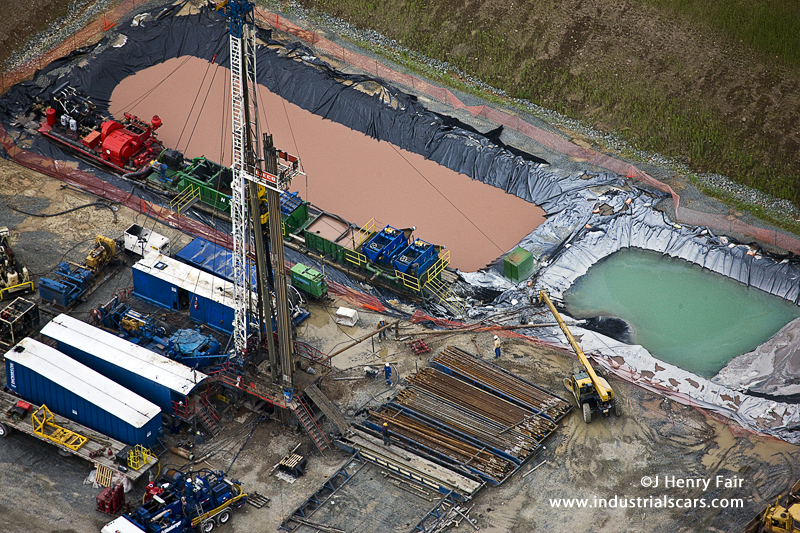
Hydro-fracking drill sites during drilling process with drilling slurry containment pondThe process of fracturing rock to create a cavity in a thin layer of shale, deep under ground, to extract the gas trapped in cells there does not create a large pocket. So, only a small amount of gas is produced, and the well is exhausted quickly. Given the low volume of gas produced by a single well, sustained supply depends on the production of many, many wells, which means many leases must be signed with landowners. As the gas rush caught on, there was a big push by gas drillers to sign as many leases as possible, as these "reserves" increased the company's value, and thus its stock price. When those leases began to come due, they had to be exercised, or else they would expire, thus increasing the market glut.
In any resource extraction rush, the easily obtained reserves are the first to be taken, and as they dwindle, more difficult and expensive assets are pursued until such time as extraction cost plus profit exceeds market cost, at which point extraction ceases.
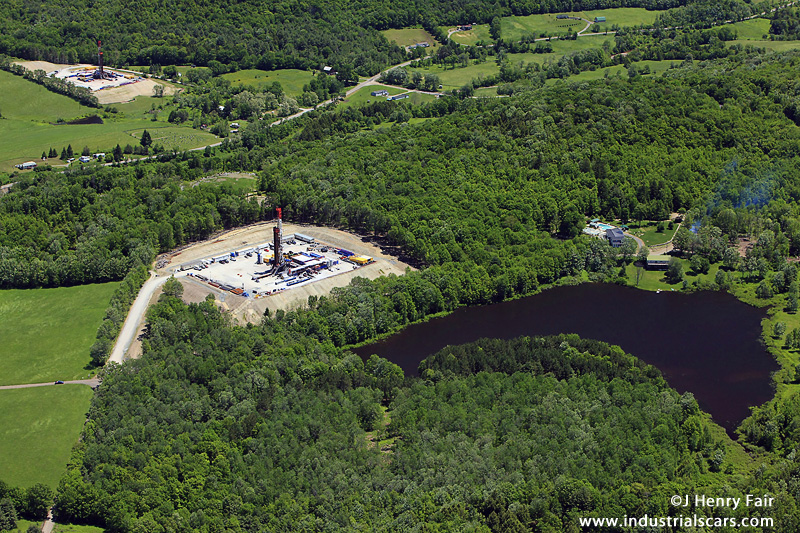
Hydro-fracking site with drill rig next to pond, cut out of forestThe Energy Information Agency has predicted that the USA will shift much its energy production to natural gas in the coming years, based on the imagined plentiful supply, and clean combustion characteristics of this fuel. With the sudden oversupply brought on by the hydro-fracking rush, the price of natural gas has plummeted with numerous consequences. Most alarmingly, the bottom has dropped from the sustainable energy markets, as gas has became cheaper than wind or solar, which have already become competitive with oil and coal. Given the low price, and the EIA predictions of plenty in the future, many industries have placed significant investments on gas-fueled technologies. Last year, the USGS significantly lowered its estimate of recoverable gas in the East Coast shale deposits to at least one twentieth of their previous estimates, upon which the gas bubble was based. But as the money was already invested, there is little discussion of this.
The oversupply of gas in the USA has driven domestic prices to about a fifth of the worldwide average, a situation that can only be temporary. Last week, a pump on a gas pipeline supplying Britain from the continent failed, causing a 50% spike in wholesale gas prices. Though it was not revealed at the time, Britain, suffering an unusually cold winter, was down to a two day supply of gas. This week it was announced that a US gas company had signed a contract to supply hydro-fracked gas to Britain, starting in 2018, in the form of liquid natural gas, via tankers loaded in Louisiana.
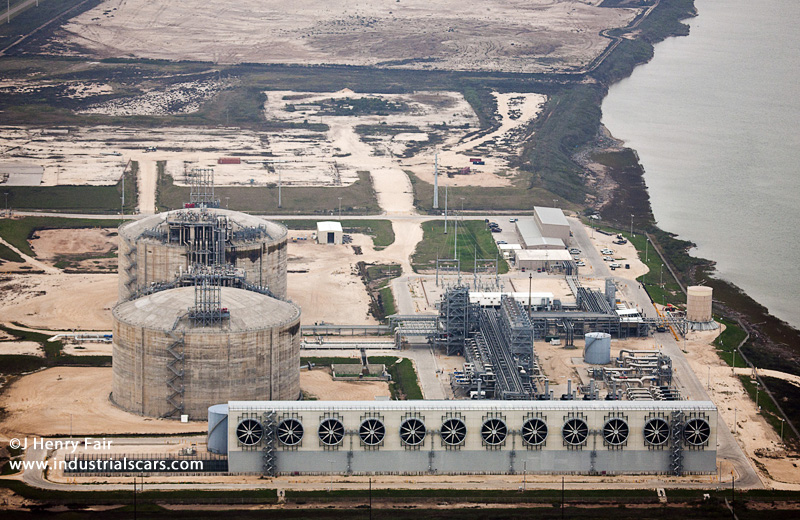
Liquid natural gas compression terminal
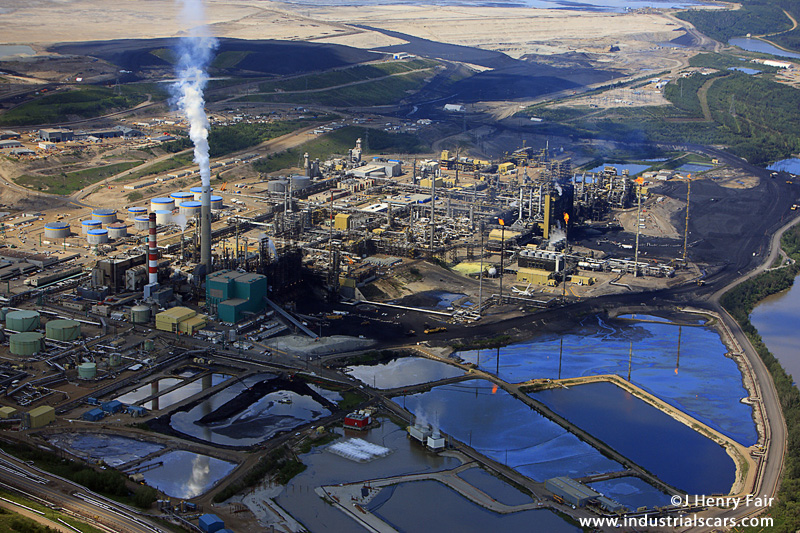
Oil sands upgrader in AlbertaIn the last few years, the EPA has finally enacted air quality regulations that will force electricity utilities to either retire or upgrade the most dangerous coal fired power plants. Many of these utilities, taking into account the projections of future gas supplies, and current USA market price of gas, are converting their electricity production to natural gas. In 2000, the USA produced 51% of its electricity with coal, and 16% with gas; in 2010 the ratio was 44.5% and 24.1%, and the trend continues.
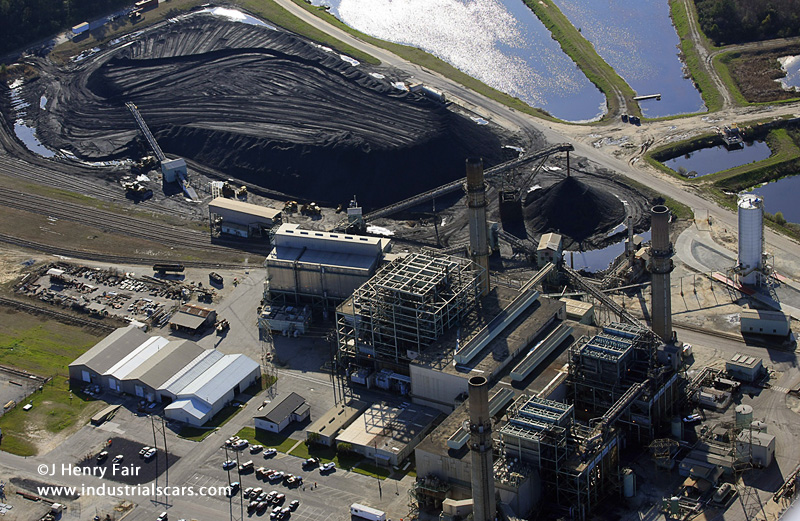
Coal fired power plant in SC, soon to be retiredSo let's add up all of these facts and draw a few conclusions:
-tremendously overstated supplies
-an overstatement upon which bankers make large investments
-increasingly expensive and difficult reserves remain for extraction
-commitments in place to sell gas overseas in markets with higher prices
-numerous domestic industries (especially electric utilities) implementing technologies to utilize the erroneously projected plentiful, cheap gas supplies
-coal powered electrical generation converted to natural gas to avoid the expense of adding pollution controls
-Wall Street wants its money back before the bubble bursts, so the pressure is on the gas companies to keep drilling wells and producing gas to pay the interest on the loans.
So where will that leave us, the average citizens in the USA?
The first thing that will affect all of us will be a tremendous spike in electricity prices in the next few years as US natural gas prices equalize with world market prices, which will have risen from current levels due to the voracious demand of Europe, Asia, the tar sands, and diminishing world supplies. More importantly, we will be faced with depleted and polluted groundwater, and tremendously degraded farmland here at home as we rushed to keep the bubble inflated.
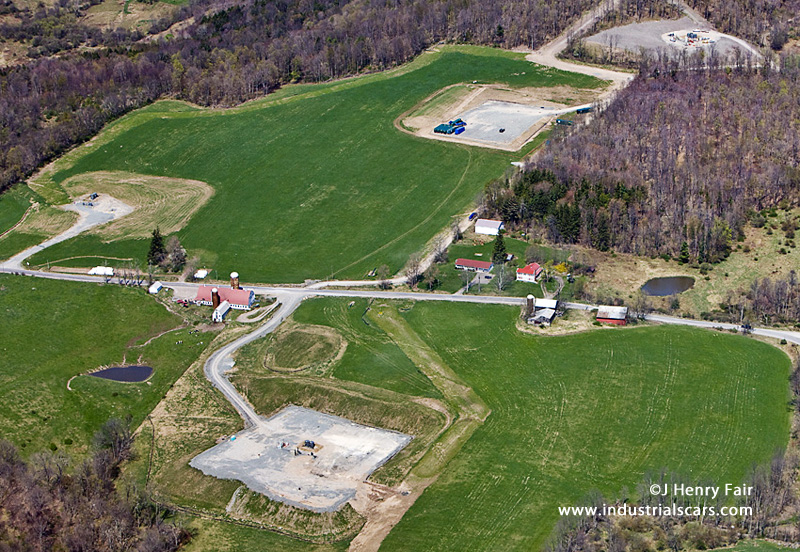
Farm with four completed hydro-fracking well pads07 March 2012
Marc1
Currently, in the pincushion once known as Pennsylvania, the new scheme is to run a pipeline through the Endless Mountains. The appeals to the reason of the courts have been struck down by the arm of the American Petroleum Institute, once known as the Pennsylvania legal system, and the logging machines are in gear, like the army of Saruman, cutting a wide gash through the wilderness in preparation for the giant ditch soon to follow. Run, ye precious flora, fauna, and nature lovers alike, your haven is destroyed.
So, like the armies mustering for the battle of clear futility, I prepare to fly today to photograph the destruction.
The similarities to the Lord Of The Rings are just too precious.
LightHawk, personified by the great aviator Bob Keller, like the Great Eagle who rescued Gandalf, will take me to enjoin the battle wherever we find the machines of desecration on their tortured path.
But like true believers, we never concede defeat, living in the hope of the miracle - that the citizenry will awaken to their peril, throw off the mind-numbing media oppressors and rise to the occasion to demand a shift to a non-hydrocarbon economy.
We promise to be generous when the poor people of Pennsylvania ask us for some of our water.
01 December 2011
Partners
Some of the most important partners are the pilots that volunteer their time, expertise, and equipment, most notably SouthWings, LightHawk, and Motorfluggruppe Grenzland. Recently, after an exhibit in Amsterdam, a Dutchman named Leo Westerkamp called asking if there might not be a project for which he would be essential. As Germany was next on the itinerary, a revisit to the giant open-pit brown coal mines at Garzweiler seemed to be in order.
So many have questioned my grip on the slippery concept called reality, that it's rare for me to doubt another's grip must mean they are in an extreme. Leo flies a kite. With a big fan. In the winter. Somehow I let him talk me into it.
I had to run from my exhibit at Flo Peters Gallery back down to Nürnberg to teach at Städtische Berufsoberschule für Sozialwesen, and we agreed that I would then train it up to Dormagen where he would meet me. On the internet I located rooms at Nikolaus Kloster for a reasonable rate where we were blessed by the Pater. The next morning broke clear and blue, but a little windy. Turns out the kite can only fly in very still air. So we spent much of the day driving around through the ghost towns slated for demolition prior to removal from existence for access to the coal below.
This woman was one of the last residents of Frimmersdorf, but in true German pride, was still sweeping the street in front of her house. Finally, the wind subsided enough to allow flight, but only for an hour plus before sunset.
On each flight, I usually find at least one answer, and in this case it was the disposal of the ash from the trio of power plants fed by the mine. Regular readers of this rant (and other properly concerned citizens) know too well about coal ash and its threats to our health. As I suspected, the lovely power provider in question is dumping it right back in the mine, unlined from the water table, thus allowing the lead, arsenic, uranium mercury, selenium et al found therein to leach into the groundwater. Glad I don't live near there.
When doing these projects, the faithful, ancient GPS always accompanies, and a quick mark of the point of departure seems a sensible precaution. Nothing like a trail of bread crumbs. As the sun was setting and the cold intolerable, I called for home, and Leo averred that he had it under control. In good faith, I allowed him to set the direction, but always the dubious, I cast a glance at my bread crumbs, which oddly went the other way. Upon query, Leo assured me all was under control, but when the mine appeared through the haze in front of us, I knew that my suspicions, though founded on crumbs, were credible. Visions of spending the night in some field huddled next to Leo, wrapped up in his giant kite were not comforting. Fortunately, Mr. Magellan, old as he is, guided us straight back to the air field, though I could hardly get off the kite when we finally bumped to a halt.
09 June 2011
El Paso
Mexico provides labor, an escape for corporations from American environmental regulations, and fuels an industry of border security. Copper was the primary product of the smelter. Nearby in New Mexico, are several large copper mines owned by a mining giant with an environmental record less than pristine.
When my friend the writer Roger D. Hodge mentioned he was going down to work on a book about the border, I immediately asked to accompany, and called LightHawk, that great organization of environmental pilots, asking if they had anyone in the area. Merry Schroeder from Santa Fe volunteered, and agreed to fly down and pick us up in El Paso. In spite of the forecast for high winds, which make flying and aerial photography quite difficult, the day broke calm and clear. Due to the stress of flying in and out of El Paso, Merry wanted to fly from the left seat, which has the opening window, but we agreed to touch down when we arrived at Silver City, NM and change seats. Shooting through a window is highly problematic for numerous reasons: reflections in the window, loss of contrast and resolution shooting through the plexi window, and the inability to look down. At the airfield were several fire fighting craft: a large helicopter and plane, undergoing maintenance from their duties fighting the wildfires in New Mexico. In spite of my entreaties, Merry insisted that the air space was restricted, and that we could not fly there and photograph. So we changed seats and proceeded to the nearby mines and smelter.
Open pit mines are possibly the most visible of “industrial scars” and the trick for me is to take these disasters, inherently ugly detritus of our consumer culture and create images that captivate the attention of the viewer. Ultimately this is about using the rules of color and composition, and, in that five seconds of attention, stimulate interest and curiosity, and tell a story.
By this time, the wind was picking up, which makes positioning the plane quite difficult. The details I'm interested to shoot are very specific, and in a plane, one has but a second, literally, to get them. Merry is a very skilled pilot, and was able to put me in the proper place repeatedly. Between the bouncing plane, and the wind tearing at the lens, getting that tight, exact, composition ain't easy, so
around and around we go. Thanks to exemptions in the clean air and clean water acts, mining wastes are exempt from reporting, so the real impact of these mines is unknown. Art can somehow fill that gap, as a picture does not lie (like a politician). And only through the collaboration with people like Merry and LightHawk can these stories be told. We photographed two mines and the accompanying smelter, then headed back to El Paso where we were interested to see the border fence. The fence, so imposing from the ground (and such an environmental barrier) is hard to photograph from the air. It becomes a demarcation line, an effect that is very visible. The other quite visible effect is the traffic queuing up to come in to the USA. So much money is being spent on an intractable situation that will only be remedied when the underlying causes are addressed: economic disparity and drug use in the USA. Until that time, the fence is but a monument to futility, not to mention a repeat of a similar mistake. Fortunately, the Mexicans we are trying to exclude don't have the same intent as the Germans did.
03 May 2011
Just Say 'NO' for Earth Day
Strolling around the Earth Day exhibit at Grand Central this year, I was struck, not so much by the environmentalist fervor of the event and participants, but by the mercantilist nature of the event. Leggy, breathless blonds touted the efficiency of washing machine/dryer combinations (as if a dryer were not the most earth-unfriendly device made). A life-sized mural of models, photographed in a “life-style” manner, urged us to buy some brand of apparel “for the good of the planet” (buying organic cotton is good, as cotton is the crop on which the most pesticides are sprayed). Toyota was there with the Prius, which is unavailable, due to the seismic sea wave (not tidal wave) and accompanying nuclear disaster. And there were a few moms and kids milling about with crayons and happy faces. But the overarching message (maybe I’m a cynic) was: buy Buy BUY!
I’m the first to believe that we can change the world by careful choices of what we buy; as a matter of fact, I think it’s ultimately the only effective vote the individual has. Our real problem is heedless consumerism, on every level, whether it’s buying the new iPhone or leaving the lights on, it’s our consumption binge that is the problem. That means you and me.
03 February 2011
Thank God, the Ice is Melting...
Our hunger for petrol and dwindling supplies are driving exploration farther afield, and the Arctic is the next on the list for extraction.
The recent spill in the Gulf Of Mexico taught the world much about oil spills and response. Fortunately, the spill happened in the spring within 200 miles of some of the most well-equipped ports in the world for offshore oil operations. In the Beaufort Sea, where Shell is preparing to drill north of Alaska, there is not a deepwater port for a thousand miles, and that one is a one-horse harbor in the middle of the ocean. The water in the area is only navigable a portion of the year, and periodic storms with “sustained winds may reach 65 to 70 knots; significant wave heights can climb to 40 to 50 feet” occur every few years.
A recent European study on Arctic weather forecasts "large increases in the potential for extreme weather events" and warns that "commercial activities in the North (e.g. fisheries, oil industry, shipping) will become increasingly vulnerable" to severe Polar low-pressure systems, described as the "Arctic Cousins" of tropical hurricanes.
Of course, as the weather gets rougher, accidents will increase and remediation becomes more difficult.
Until recent years, technology limitations and low oil prices have kept this vast repository of hydrocarbon wealth essentially out of reach of extraction. Those limiting factors are rapidly diminishing and oil companies are rushing to get a stake in the action. Logically, disasters, delays, and cost overruns would be directly proportional to severity of site conditions and distance from logistical support.
Some recent developments in Arctic petroleum exploration/extraction:
-The Norwegian national oil company Statoil has been producing gas from its Snøhvit drilling site above the Arctic Circle since September 2007. The ambitious project is completely sub-aqueous, and has been plagued with delays, overruns, and un-permitted greenhouse gas releases since the beginning. Statoil is one of the biggest players in some of the dirtiest hydrocarbon projects in the world, including the Catskills hydro-fracking controversy.
-BP has recently signed a deal with the Russian state-owned Rosneft to explore the Arctic areas off Russia’s continental shelf. Neither Russia or BP are known for their attention to the environment or safety record.
-Shell has received permits to begin exploration off the north coast of Alaska in the Beaufort Sea, and is moving equipment, including a drill ship and a newly built spill response ship into the area in anticipation. When one remembers that thousands of vessels were involved in the BP Deepwater cleanup, and one specialty disaster response ship seems inadequate. Shell has a record of environmental destruction and governmental manipulations in their projects around the world.
-Cairn Energy began drilling off the Arctic Coast of Greenland this summer, but had to stop after GreenPeace activists suspended themselves from structure of the drill rig.
If you were hoping that peak oil would arrive and provide the restraint that we seem to lack as a species, vis-a-vis our carbon addiction, think again. The dirty oil sources (like the tar sands) will allow us to continue to push up the atmospheric CO2 meter at an increasingly accelerated pace. Of course, when all of the ice has melted, the oceans will only rise 220 feet, so if you are in the mountains you’ll be fine, except for the sunburn...
28 September 2010
Artist or Activist?
Artist or activist? This question frequently arises in relation to the Industrial Scars project. The work is first and foremost art [works to be appreciated primarily for their beauty or emotional power]. Many years of study into the rules of composition, color, and lighting have gone in to their making. The images hang in galleries and museums, and fetch high prices from collectors. All that said, the subject matter is highly contentious, which inherently makes the work political. There is plenty of precedent for this in the art world from Goya to Picasso to the artists of the Third Reich. This is art with a message.
One current project, Coal Ash, is about the 140 million tons of toxic waste generated as power plants burn this most polluting hydrocarbon to produce our electricity. Coal combustion waste (CCW) contains mercury, lead, arsenic, boron, selenium, and so on, but the utility industry has managed to keep it designated as non-toxic. Most of the 600 coal-burning power plants in the USA dispose their waste ash in unlined impoundments, from which the ash leaches into groundwater, or worse, bursts out and poisons the surrounding land and waterways. The other method of disposal is in your home. Because of its designation, utilities are permitted to sell the waste to manufacturers who use it as a component in: sheetrock, concrete, fertilizer, fill, paint, and a host of other products.
The EPA is currently holding hearings about the designation, and environmental groups are fighting to have it reclassified under subtitle C of the Resource Conservation and Recovery Act (RCRA) so that it must be handled as the toxic waste that it is. Every citizen has a personal stake in this as this toxic waste might already be in your home, and given the dispersal of coal-fired power plants, there might well be a coal ash dump near your house, contaminating the groundwater with arsenic.
Today I am in Washington DC where I will, along with the help of EarthJustice, lobby congressmen about the rule change, and then hold a reception in the Rayburn House Office Building, Room B-369.
Long-lasting change in our society ultimately happens through political machinations, which are foreign to me. Since my art is about things that need to change, this is an exciting adventure. And thus, the artist becomes activist.
08 September 2010
What Can I Do About It?
Climate change is a contentious issue currently, generating heated rhetoric, tremendous media expenditures, and much disinformation.
Dr. James Hansen, the scientist who is the leading U.S. expert on climate issues is focusing on cutting our coal use as the most effective thing we can do about global warming. Coal combustion is a significant contributor to climate change, and comprises 50% of electricity generation (in the USA.) We can easily affect this by reducing electricity consumption (turn off the lights, unplug appliances).
About 25-35% of climate change gases are caused by deforestation, the greatest portion in the southern hemisphere. Agriculture, commercial logging, and homesteading are some of the major factors driving this conversion, and each of them has a host of contributing elements, many of which point back to consumption in the more “developed” economies. Deforestation will remain a complex, intractable issue, but the individual that wanted to minimize her contribution to that process could consider: not consuming fast food made from livestock raised in the southern hemisphere, not driving (biofuel use of palm oil), and avoiding other uses of palm oil.
Soda consumption is a little considered, but significant cause of climate change on several levels: aluminum production uses prodigious quantity of electricity and releases large amounts of other greenhouse gases. Recycling one aluminum can save enough energy to run a 100-watt bulb for 20 hours, a computer for 3 hours, or a TV for 2 hours (EPA, 2008). The climate change impact of the contents of soda would be another fascinating discussion.
Motivated by ideological agendas, it's easy to vilify the scientists who are trying to explain this very complex issue (climate change), especially if they make a mistake or are seen exhibiting human weaknesses.
Though the science now seems certain that warming is occurring, and that it is in part human-caused, no one can predict the exact effects or timeline of climate change, so there will inevitably be misestimations. We know that when all of that ice melts, sea levels will flood coastal areas. This will drive mass relocation of populations, putting a tremendous strain on the “higher ground” areas. Weather patterns have already started to change, which will affect agricultural production. Probably these changes will not happen overnight like in a science fiction movie, but there have been drastic overnight changes in the past, so they could. Bottom line: the risk is too great for inaction, and the individual can make a significant difference on the issue.
17 August 2010
A World Gone Crazy
The rest of the world clings tenaciously to the myth of Obama: that he will bring sanity to the USA and its relations with the larger world. Admittedly, the rabid opposition that would ruin the country before allowing progress stymies much of his effort. Politics is a curious melee wherever it is practiced, swinging back and forth between poles, which seem to gradually drift rightward with the influence of corporate money. This is written from the comparably sane vantage of Europe, but the comedy of Berlusconi and stalemate at the Bonn Climate Conference make clear the prevalence of illogic. Meanwhile, the USA is still the country that tortures, is still having teens kill innocents remotely, still fighting unwinnable wars in two countries with massive civilian death tolls, and even our best efforts at climate control are tepid. So Obama is really the same animal with slightly different stripes; and he is the American politician that received the most campaign contributions from BP between 2004 and 2009 ($77,051.)
Meanwhile, fisheries in the Gulf have reopened, with a small codicil from the FDA that if the seafood doesn’t smell like gasoline, it is safe to eat. And The New York Times is declaring that the Deepwater spill is really not as bad as initially reported, with much of the oil evaporated, dissipated, dissolved, or disappeared. Of course BP will write off much of the cost of the cleanup, thus passing the buck on to the shoulders of the taxpayers, and Obama wants to allow drilling again. In a world gone crazy, sarcasm seems the only logical response.So all is again well in this best of all possible worlds, in spite of the annoying unwillingness of the economy to create any new jobs as we ship the old ones off to the undeveloped world. Fortunately, the fisherman in the Gulf can return to work. Clearly Tony Hayward was right all along: it wasn’t much oil compared to all of that water in the ocean.
And what about the all that extremely toxic dispersant that was pumped and dumped in the Gulf? What about those disquieting rumors of BP and its Coast Guard lapdogs secreting the carcasses of whales and dolphins away in the middle of the night for disposal? Where are those submerged plumes of oil? What will happen to coastal residents who inhaled all of that sprayed Corexit blowin’ in the wind? The stories of persistent flu-like symptoms and other health issues are un-discussed on the major media.
Clearly the dispersant corrected the problem: out of sight is out of mind. And though the issues it will cause are really just beginning, it and the spill are no longer news.

Another interesting issue to the whole situation is the climate change impact of the whole thing. Between the continuous burning of the skimmed oil (and inadvertent ocean fauna caught in the skimmers), the flares burning captured gases, and more important, the tremendous amount of methane and other volatile gases that gushed out of the hole while it was open (oil was only a small part of what came out), the climate change impact of this disaster is immense.
The larger question is what about the resolve, echoed by every president in living memory, to move the USA to a sustainable energy future? Have we wasted the potential benefits of this crisis?
The last trip I made over the Deepwater site was after the leaky cap had been removed in preparation for the tightly fitting cap that stopped the leak, so oil was gushing freely, thus leading to some of the most interesting pictures yet.
06 July 2010
Whitesville
I’m in Whitesville, WV with Jim Hansen, the climate scientist, to attend Larry Gibson’s annual July 4 party. I’m here to do a portrait of Dr. Hansen, see Larry, and to go to his legendary fete. To entertain myself, I decided to bring an old Rollei f, truly one of the great cameras; it’s such a joy to shoot a little film. Remember black and white?
Larry is truly a modern David, squaring off against the goliath of king coal, personified by Don Blankenship, president of Massey Coal. To look at a satellite image, or better, to fly over Larry’s land is to laugh and cry simultaneously. An island of green rises from a despoiled expanse of regurgitated overburden from mountaintop removal mining. Modern mining processes, through mechanization, have inversed the human cost with environmental damage. Ironically, the corollary human toll is unemployment and decay of the communities that were supported by human-powered mining.
Resource wealth rarely benefits the populations in the rich place, those fortunes tend to be extracted to the same place whence went the resource. The people that remain are generally left with poverty, decaying infrastructure, and environmental nightmares.
Main Street, Whitesville is evidence of that pattern; of the few operative concerns were two funeral homes, a few stores (chain saws, floor coverings, five and dime), and of course a few churches. Most of the storefronts are haphazardly boarded, some with love notes written in the dust covering the windows. Dust near coal facilities is a tremendous health issue, and asthma tends to be high. Down the road is the Marsh Fork Elementary School, next to another Massey Coal processing plant. Above the school is an earthen dam holding millions of gallons of “slurry,” the chemical soup used to clean coal before it can be burned and continue its life cycle of destruction.
One can only imagine what Whitesville was like in its zenith, hard to picture all of the stores open and people on the sidewalks.
The people in Appalachia are some of the most vocal supporters of coal mining, and who can blame them? Their lives are at stake. If you lose you lose, but if you win, you really lose. Without coal they have no jobs, but with coal they have desecration, pollution, and asthma. Just down the road is Coal River Mountain, a summit steeped in legend and controversy. For years Massey pressed for permits to begin blasting apart the mountain for the coal underneath. The residents floated a proposal to build an array of windmills on the top, a solution that would have provided clean electricity and jobs forever, as opposed to the dirty and short-term plan of Massey, after which would remain a wasteland. Blasting began last year and destruction of the mountain is moving forward.
There is a better way. It won’t mean loss of jobs and decimation of the economy, to the contrary.
We must demand it.
15 June 2010
Saratoga Rig: Just the Facts
A journalist, in theory, wants the facts; an artist, the essence.
I consider myself the latter.
While studying satellite imagery from the Gulf of Mexico, SkyTruth spotted an apparent slick from an oil platform and cross referenced the location to MMS info which showed it to be platform 23051 at 28.938022 - 88.970963. SkyTruth, knowing I was in the area shooting the BP Deepwater Horizon (Macondo well), asked me to investigate the location. SouthWings pilot Tom Hutchings agreed to fly by this site after our planned overflight of Macondo.
Upon navigation to the coordinates, a rig was spotted with an apparent petroleum slick on the ocean surface that extended beyond the limits of vision, and the assumption was made that this was the site in question. Next to the rig was a large boat with wake on both sides (as opposed to from the stern), but not moving. On the deck of the boat, men stood next to 9 barrels and a hose which hung over the port side of the boat. There was a yellow buoy or other flotation device where the hose entered the water. Several circles were made around the site, during which time the boat still did not move. Close-up photos show the name of the rig to be “Diamond Offshore Ocean Saratoga,” and the boat, the “Ram Charger.”Further examination of the photos shows in the distance an object with what appears to be another long slick, and comparison hand-held GPS coordinates taken from the plane are in a different location than the original coordinates given by SkyTruth. Thus, there are two leaks.
Taylor Energy (now owned by a Korean holding company) holds the lease on the well and states that they are:
“renting a rig from Diamond Offshore Drilling Inc. to plug wells that were destroyed by an undersea mudslide during Hurricane Ivan in 2004.” (Quoted from Reuters)
and:
"As a result of deploying three subsurface containment domes and performing six successful well interventions, the initial average observed sheen volume of nine gallons per day has been substantially reduced."
The leak we see in the photos appears to be much greater than “nine gallons per day.”
Taylor said:
“the photos had incorrectly identified a leak coming from the Saratoga, whereas at that time the company had actually been operating a 180-foot dynamically positioned workboat for a scheduled containment system drainage.”
But curiously, in the next paragraph we read:
“Gary Krenek, Diamond's chief financial officer, had said earlier that while his company was required to report spills off its rig, and had not done so, it was contractually unable to discuss anything further.”
He referred questions to Taylor.
So they broke the law and can’t discuss it?
The official story does not jibe with the observed facts.
Meanwhile, after we announced the spill, the share price of Diamond Offshore dropped sharply. Alas, I am neither clever nor stupid enough to short a stock prior to releasing my photos, and I spent a day dodging calls from media and hedge fund operators. The fixation on quarterly earnings, and the gyrations and machinations of the stock market place our society in great peril on many levels.
Rather that fixating on the possibility of a well leak in regards to what it might mean to the stock price of a company, we would do better to fixate on what it means to the dolphins and the turtles, and our grandchildren.
According to a reporter from the Mobile Times Register, there are 600 unexplained leaks per month in the Gulf. The Diamond Offshore occurrence(s?) may or may not be a leak. The BP Deepwater Horizon may or may not be the largest spill in the Gulf this year. There will be many, and at some point, the culmination will overwhelm the flora and fauna that have teetered back from the brink so many times before. Then we will have systemic failure, and the Gulf becomes a dead sea, the consequences of which exceed comprehension. Just the litigation around the impacts of this one instance is incomprehensible.
The Conservatives decry the Liberals for forcing the oil companies to drill offshore rather than get the easy oil in Alaska. But the fact remains that resources are limited by definition, and our increasing hunger for oil will drive acquisition to the darkest corners of the planet. To get there, we will push the limits of technology, which means more accidents…
04 June 2010
Notes from the Gulf - part 2
Another hot day.
Our plan was to fly west to Queen Bess Island, west of the Mississippi River where BP is rumored to be hiding oil-soaked animals, but a storm front prevented us from flying there. We instead decided to go straight for the source.
As soon as we leave the shore, we see oil. The wave crests have a strange texture, and the wind makes abnormal patterns. As a long time sailor, I can see it, and am more aware of it on this second flight. Oil calms the water.
Preparation is so important on these projects.
I have decided to try tapping off my lenses ad nauseam, instead of letting the auto focus work. Hopefully that will allow a faster shoot response time.
The source site is completely different.
We hear that overnight the LMRP was put over the severed pipe, but that only a fraction of the oil is being captured.

We see less oil on the surface, or rather it does not have the same multi-colored sheen. The drill ship is flaring gas, and a tremendous plume of oil seems to start there and extend downwind. It is a different color than anything we have seen before, very brown. There are more planes at the site which makes operation in the area hazardous. At one point a plane passes just below, disconcerting.
The flare is fascinating, and we circle repeatedly. Because of all of the traffic, we cannot go in as close as I would like. The skimmer teams do not seem to be so effective, as the quality of the oil is different. Two days ago the skimmers made a noticeable trail when they passed through the oil, but not today.
More later...
03 June 2010
Notes from the Gulf
Arrive at FairHope, AL Airport, thunderstorms approaching.
We decide to go eat breakfast and wait for storms to pass. Grits not bad, biscuits mediocre.
Taking off in a Cessna 182.
Rear seats and cargo door have been removed to enable photography.
As we get offshore, I see sunshine on Dauphin Island, which has had “no swim” directives issued today, as the oil is supposed to hit Alabama shores today.
Seeing first oil. Bright red tendrils and sheen on the water. Dodging thunderstorms as we make our way out to “the source” as it’s called. It’s a bit surreal like Apocalypse Now, going through the clouds, music playing in the headphones, knowing they are right now desperately trying to cap the gushing pipe on the floor of the ocean.
We count 37 vessels involved in skimming operations, and 15 ships at the source. There are two drill rigs, one drill ship, and one utility rig at the source.

Everything leaves a wake of oil, either from its movement or the current. The skimmers are generally two boats with a boom/net between them. The oil is sometimes red, sometimes “oily” colored. Interestingly, it’s hard to shoot as the red is more visible when reflections are cut and the oily layer on the surface shows up with the reflected light.
Other rigs on the water seem to be operating “business as usual.”
Don’t see the beaches covered in oil that the media has led me to expect. Maybe that’s further west in Louisiana?
Everywhere there is an expectation of disaster approaching. This must be similar to the approach of a hurricane.
For years I have expected an infrastructure disaster here in “hurricane alley” where 40% of our oil is refined. Not sure what percent originates here.
To see a few more images from the Gulf, click here.
02 June 2010
What Next?
'Top Kill' has failed.
'Junk Shot' has failed.
Now they propose to cut off the pipe and drop a funnel over it.
The entity once known as British Petroleum behaves like a rogue cattle thief, ignoring government directives and the muted indignation of the population, who, in their misguided disaffection, are now blaming a president who inherited the patronage-based mess from the oil industry presidency that went before.
Meanwhile, the natural systems, oblivious to the machinations and hand-wringing of the humans above, continue to bleed the toxic goo into the ocean, where BP sinks it with the Orwellian-named dispersant Corexit, and then has the gall to say that it never existed. The public nods dumbly on, abdicating the responsibility of citizenship to the directives of the corporate big brother.
Where is the outrage?
Where is the personal commitment to stop contributing to the problem? Have we all sunk so far into self-indulgence that we can’t even see our complicity?
I’m flying from Houston (capital of the petro-based economy) to Mobile, a city bracing for the onslaught of oil tomorrow. The clouds seen from my window over the Gulf are a surreal red, lit by the evening sun filtered through the pollution above Houston.
Between the hydrocarbons bubbling out of the water into the atmosphere, and those being burned, the Macondo site generates its own weather.
What will it take for people to generate the appropriate outrage and demand sensible action? Dead dolphins floating to the beach? Pristine beaches covered in tar? Plummeting property values?
(BP will probably collect the dolphin carcasses in the night like during the plague, and tell us there were none)
There is a team of dedicated people watching the events unfold, and trying to clarify them for the media and the public beyond the usual sound-bite coverage.
Tom Hutchings, Southwings pilot, is out flying over the horrors of the Macondo site on a daily basis. John Amos and Skytruth are getting current satellite imagery and interpreting it so we have some overview of the progression. Don’t listen to the people that have a vested interest in this issue, listen to those lonely voices with a penchant for the truth.
This is big. Don’t believe otherwise.
28 May 2010
THE BEGINNING OF THE END
Some days pass with hardly a thought of it. Other days are literally oppressed with the weight of the oil and gas pumping into the Gulf.
Our real Gulf crisis has begun. Perhaps it will be the first sea to die. Completely.
And the sight of the various guilty parties sputtering denials and accusations makes me think of teenagers caught red-handed at some obnoxious prank.
Hearing Tony Hayward (CEO of BP) say, "The Gulf of Mexico is a very big ocean. The amount of volume of oil and dispersant we are putting into it is tiny in relation to the total water volume," makes one either apoplectic or catatonic (depends on the day). The insight here into total corporate control of the regulatory process and government is a discussion of its own.
Three things confound in this situation:
-Corporate arrogance, greed, and short-sightedness
-Our blundering non-understanding of the natural world, its complexities and frailties
-Public indifference
The first two are to be expected, but the indifference of the public is staggering. We have managed to totally divorce action and consequence in our minds. Every time we start a car, every plastic bottle we buy contributes to this disaster, but like true schizophrenics, we do not connect cause and effect. We wring our hands in concern about the oily birds and beaches, and then wash our hands with soap from a plastic pump dispenser.
We are the problem, not BP, not the US Government, not the MMS.
And of course, the long-term battle of hearts and minds has already been lost with BP’s clever application of vast quantities of dispersant and tight control of media coverage coming from the battlefield. Corexit broke up and sank the oil, so the impact on the Gulf Coast beaches will be a fraction of the reality. The undersea flora and fauna, however, will never recover. The Gulf, already severely wounded from the phosphates pouring down the Mississippi, is really a large bowl, with a circular current fed from the Atlantic. As those submerged oceans of oil swirl around and sweep past Florida, they will be caught up in the Gulf Stream, and ultimately be deposited in the Georges Bank, thus finishing the decimation of the world’s greatest food source.
But the public won’t see it, thanks to the dispersant and BP’s adroit image control, and this will drop off our radar like all the other clarion calls warning of the imminent collapse of the natural world that sustains us.
Drive on.
12 May 2010
Exposition at Spedition
Locomotive Turntable at Bremen Station
Planning and preparation for this production have been proceeding for years, with Nicolai Burchartz of Koeln and Gregor Straube of Bremen doing the heavy lifting.
The mission was to put up a show of new work, all large murals, themed “What happens because of the things we buy.” The exciting new aspect of this exhibit was the inclusion of an interactive component that explains each mural with maps, satellite images, establishing shots, and information. These pictures can be seen on so many levels: aesthetic, documentary, political, that viewers demand explanation, and providing that information is a challenging enterprise. Working with several classes of German high school students would explore the cross-cultural impact of the images and the interactive program.
The team at Spedition was relaxed, efficient, and thorough, so the exhibit went up like a balloon and looked fantastic, done in the unique “Spedition style.” The vernissage was quite the success in spite of the rain, boasting the senator of the environment, among many.

Talking to the students from the Wilhelm Wagenfeld School, and the other people passing through was the most rewarding part.
The students were thoughtful, aware and curious, and gratifyingly intrigued with the interactive. 
Environmental issues are making the world a frighteningly small place, and these teenagers would be the ones to bear the first major impacts. As estimates of the volume of oil spilled in the Gulf had grown too large for the brain to grasp, we discussed the root causes.
Middle Europe is colder than normal, and many Germans bemoaned the cold and rain. One wonders if the weather is the result of the volcano or other weather pattern alterations.
The Starbucks in DeGaulle Airport is surrounded with large backlit images, most of beautiful exotic animals, the others of beautiful exotic women in beautiful exotic vacation spots.
Meanwhile, the waste generated by just this one small franchise in one airport defies comprehension. The Starbucks in Köln/Bonn Airport at least offers the option of using china mugs, thus saving a good bit of paper cup waste…
Of course, the intrepid eco traveler never goes anywhere without his own air-tight mug that goes right in the bag. And who would throw away a good cup of java just for security, knowing the cost?
04 May 2010
Up the Lazy River
The Ruhr River area is one of the oldest and most concentrated industrial areas of the world. It has been the hub of German industry, and the foundry of their might, both military and economic. Concurrently, it is one of the oldest toxic areas in the world, and the patient reader knows of this writer’s fascination with such things. Having photographed other environmental issues in Germany over the years, a compulsion to study the Ruhr became stronger with the passage of time, and so arrangements were made for the lovely German spring of this year. As most people might know, gambling on bluebird days in middle Germany is like betting on the good sense of the American voter,
but one must have faith, and so I found myself at a small airfield on the border with Holland, shaking hands with a taciturn expat Brit pilot.
Very interesting the absence of TSA obsession here; in the land of the free (note the sarcasm) the TSA, police, FBI, and various other enforcers of the regime are all over you if you look twice at a power plant (or even photograph a public building for that matter), whereas here, nothing is said.Germany has opted out of the nuclear game (though that is being unfortunately reconsidered) and is heavily reliant on coal like the USA. Meanwhile, there are these powerful rivers taking energy down to the sea that could easily light all of the cities in the area. And of course the German energy giants are digging up the country, displacing thousands of citizens, razing towns, and releasing tons of carbon, all to power their digging machines and light the bulbs of middle Europe.
As I write, the USA EPA has just released revised "suggestions" about coal ash. In an unsurprising Orwellian development, this toxic waste of the coal combustion process will continue to be "beneficially reused" in sheetrock, fertilizer, paint, carpet, etc. The list of ways how this toxic waste finds its way into your life goes on. Did i forget to mention that it is laden with lead, mercury, uranium, arsenic, cadmium and more?
Can we get smart about this?
29 April 2010
The Maw of Our Desire
The television screen sobs with the bereaving families of the workers lost in our industrial accidents; we glance, feel a touch of sympathy, and continue our days. The similarities among the recent hydrocarbon blow-outs bear some resemblance. Just as the voracious demand for drugs in one country fuels a ruthless genocide in another, so our thirst for hydrocarbons prompts this loss of life and habitat despoliation (that would be our habitat, btw.) From time immemorial, peons have been expendable in the service of the ruling classes, and so it remains. The media thrives on soap opera, which allows it to ignore the real drama, and we follow blithely along. We pause briefly in pity for the women in Louisiana and West Virginia, two of the poorest states in the USA, but give little thought to our culpability, or the devastation wreaked on our survival systems.
As I write, a hole on the ocean floor gushes vast quantities of petroleum into that ecosystem, while a “state of the art” robot will try in vain to plug it. Meanwhile, the wind will shift and blow the goo to shore, thus creating, horror of horrors, an unsightly mess. God forbid that we be discomfited by the detritus of our appetites, god forbid our ocean views be obstructed by apparati that might obviate the pollution. We would rather defer payment upon our children than curtail the slaking of our thirst. Like vampires, our consumer society sucks the essence from the planetary systems that support us, without consideration for those that slave to produce the goods or the debt being foisted upon our grandchildren.
19 April 2010
HYDROFRACKING
Water, water, everywhere, who needs to worry about a drop to drink?
In an effort to keep tabs on the Catskills gas drilling issue and its impact on the regional water supply, up we went for another look at the activity of the pernicious gas drillers. Catskill Mountainkeeper, Wes Gillingham, Lighthawk pilot Bob Keller and yours truly, the undesignated hydro-fracking swat team out to save your drinking water.
For those who don’t know, hydro-fracking is a deep drilling technique that enables access to natural gas reserves locked in shale formations a mile or more below the surface by pumping vast quantities of water mixed with a chemical cocktail at extremely high pressure to fracture the rock formation and unlock the natural gas therein. Permits have been issued for the western Catskills, and drilling has already begun in the adjacent areas of Pennsylvania. The process uses millions of gallons of water per well, and could easily deplete groundwater and fluvial resources. And then of course are the pollution issues: these millions of gallons of chemical–laced water are being injected down through the aquifer, and back up again.
This was our third flight, so we knew the terrain and the issues pretty well, and agreed to meet at the Poughkeepsie airfield. It was a beautiful day, clear and cool (or as clear as it gets with the always-present pollution.) Always tolerant of my meanderings, Bob and Wes had agreed to a detour to look at a few coal-fired power plants and the Westchester Garbage Incinerator. So we shot the Danskammer Plant first
(you can see their emissions report here if you want a little fright)
Coal Ash at Danskammer Power Plant
Our next stop on the tour was Lovett Plant in Tompkins Cove, just upriver from NYC.
When we got there, it was gone. How do you disappear a large power plant? Turns out, it was part of the Enron debacle (remember that) and was spun off to a company called Dynergy that refused to upgrade its pollution controls and was then ordered to close. Good riddance, New Yorkers can breathe a bit easier (turn off the lights before they build another one.) Here is the pollution scorecard on it.
The gas drilling sites we had photographed on our last expedition (nine months ago) were capped and closed, leaving only a giant industrial pad in the middle of the once pristine farm fields. It is amazing how fast they operate, drilling, fracking, and extracting in less than a year. I wonder if the farmers knew that they would be left with an abandoned industrial site in place of their farms. I wonder what the well water is like now?
We then moved westward to see some new sites, and were amply rewarded with some impressive drill rig towers, and then a site with a flare.
Flares are generally how the really nasty stuff is burned away in petroleum refineries and drill sites, so you don’t want to live near there. (Wonder if the neighbors know about that?) Then we found a site with a continuous stream of tanker trucks filling a giant man-made pond, which gives some idea of the amount of water used in this process. As we circled, we saw several tractor trailers come and go without making a dent in the level. Assumedly, there is not enough groundwater at that location to support the millions of gallons per well, so they are likely trucking it in. But imagine if that amount of water was being removed from the aquifer as it is elsewhere. Water is so precious, and we take it for granted.
Then we happened upon a site in which fracking was in process, with numerous compressor trucks arrayed around a spider rig, looking like some industrial creature being attended by its feeder slaves. Quite fascinating, actually. The amount of pressure needed to fracture the shale formation is tremendous, and I can’t believe that pumping that water/chemical mixture down at such pressure through the aquifer is innocuous as the gas companies claim.